


A practical guide to navigating mergers and acquisitions with the right Microsoft M&A tools and services
Mergers and acquisitions promise growth, efficiency, and market expansion. They also introduce complexity that can quietly erode value if not handled with precision. Business leaders are constantly asking how many mergers and acquisitions fail, why do mergers and acquisitions fail, and ultimately, do mergers and acquisitions create value that validates the endeavor in the first place.
The difference between a successful integration and a costly misstep often comes down to preparation, execution, and the tools used along the way. For organizations operating in the Microsoft ecosystem, there is a clear opportunity to streamline both pre and post merger activities by performing M&A due diligence, strategically leveraging the capabilities within Microsoft.
This guide breaks down what success looks like across the M&A lifecycle, what typically goes wrong, and how Microsoft M&A tools and outsourced mergers and acquisitions services can support each role in the organization.
Table of Contents
Why M&A Success Often Fails Before It Begins
Most M&A challenges are not caused by strategy. They are caused by overlooked operational details.
Leaders across departments tend to ask the same questions:
- What should I worry about before integration begins?
- What usually breaks during a merger?
- Who has done this successfully before?
The answers are consistent. Data silos, misaligned systems, licensing inefficiencies, and cultural friction are the most common points of failure. These issues surface quickly when two organizations attempt to operate as one.
This is where structured Microsoft M&A services come into play. With the right approach, organizations can proactively address risk areas before they disrupt the business.
Pre-Merger Success: Mergers and acquisitions Due Diligence
Tenant to Tenant Migration Strategy
- Data loss or duplication
- Identity and access conflicts
- Disrupted collaboration across teams
Pre-Sales and Financial Modeling
- Licensing overlap and consolidation opportunities
- Infrastructure cost reduction
- Long term operational efficiency
Post-Merger Reality: What To Look Out For
So why do some mergers and acquisitions fail? Even the most well-planned integrations encounter friction. The most common breakdowns include:
- Communication gaps between teams using different collaboration platforms
- Reporting inconsistencies that impact executive decision making
- Security vulnerabilities introduced during system integration
- Ticketing and support overload for IT teams
These challenges are not isolated. They affect every role in the organization differently.
Different Job Roles During M&A: Impact and Tools
A successful Microsoft M&A strategy requires a strategic M&A department structure, aligning the process and technology with the needs of employees. Below is how different roles experience the merger and acquisition process, which tools support them.

CEO: Driving Productivity and ROI
What they worry about:
- Will this merger actually increase efficiency?
- Are employees able to collaborate effectively?
What usually breaks:
- Productivity drops due to system confusion
- Lack of visibility into performance metrics
Microsoft M&A tools that help:
- Microsoft Teams for unified communication
- Viva Insights for productivity tracking
These tools provide leadership with a clear view of how the organization is performing post-merger. The question for leadership is whether their team has the technical skills, experience and bandwidth to effectively implement them for M&A deals.
For CEO’s, mergers and acquisitions consulting services is an important consideration. This is especially true when the M&A process involves complex technologies like Microsoft.
Microsoft certified Managed Service Providers make excellent candidates for M&A consulting in these cases. The intersection of Microsoft expertise and breadth of experience in M&A and Migrations enable providers like Managed solution to deliver reliable M&A consulting services to streamline the process using the very tools that businesses already own.
CFO: Cost Control and Financial Clarity
What they worry about:
- Are we overspending on duplicate licenses
- Where are the real cost savings
What usually breaks:
- Disconnected financial reporting
- Hidden licensing inefficiencies
Microsoft M&A tools that help:
- Power BI for real time financial reporting
- Microsoft 365 licensing optimization strategies
Post merger, CFOs rely on ongoing reporting to track ROI and validate the business case behind the acquisition.
IT Director: Integration and Stability
What they worry about:
- System compatibility
- Security risks during migration
What usually breaks:
- Identity management conflicts
- Ticketing system overload
Microsoft M&A tools that help:
- Microsoft Intune for endpoint control
- Microsoft Defender for threat protection
IT teams are at the center of M&A execution. Their success determines how smoothly the rest of the organization adapts.
HR Leaders: Culture and Employee Experience
What they worry about:
- Culture misalignment
- Employee disengagement
What usually breaks:
- Communication breakdowns
- Lack of unified employee experience
Microsoft M&A tools that help:
- Microsoft Teams for transparent communication
- Viva platform for engagement and onboarding
HR plays a critical role in ensuring that the merger feels cohesive rather than disruptive.
CTO: Compliance/Security and Risk Mitigation
What they worry about:
- Regulatory compliance gaps
- Increased security exposure
What usually breaks:
- Inconsistent logging and monitoring
- Misaligned security policies
Microsoft M&A tools that help:
- Microsoft Sentinel for centralized monitoring
- Microsoft Defender for endpoint and identity protection
A strong SIEM and SOC strategy ensures that compliance remains intact throughout the transition.
COO Chief Operations Officers: Process Continuity
- Workflow disruption
- Inefficiencies across merged teams
- Manual processes that do not scale
- Lack of system standardization
- Power Automate for process automation
- Dynamics 365 for unified operations
The Role of Microsoft M&A Services
- Pre merger assessments and risk analysis
- Tenant to tenant migration execution
- Licensing consolidation and optimization
- Security and compliance alignment
- Post merger reporting and optimization
From Surviving to Thriving After a Merger
Final Takeaway
If you are preparing for a merger or currently navigating one, focus on three priorities:
- Plan tenant migration early
- Align tools with role specific needs
- Invest in experienced Microsoft M&A services
This approach ensures that your organization does not just survive the IT transition but comes out stronger on the other side.
Case Study Download: Turning M&A complexity into competitive advantage.
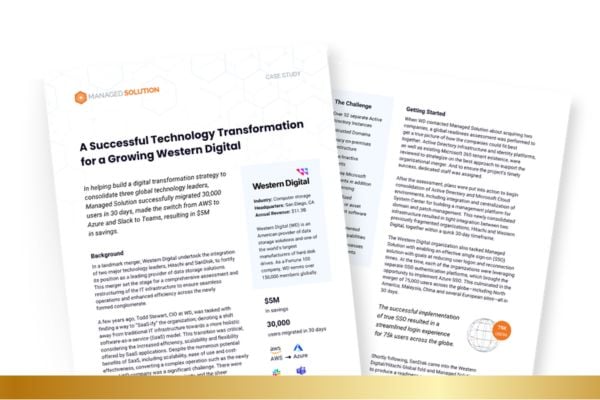
Key Highlights:
- Faster platform integration
- Cost visibility & control
- Scalable cloud modernization