


Artificial intelligence is no longer experimental technology reserved for large enterprises. Businesses across nearly every industry are investing heavily in AI and automation tools to improve productivity, reduce operational costs, and create better customer experiences.
But while AI adoption continues to accelerate, many organizations are still struggling with something much more important than deployment itself: accurately measuring AI success.
According to recent studies, over 90% of executives plan to increase AI spending again in 2026, yet far fewer organizations feel confident in how they track the value AI creates across the business. The challenge is not simply whether AI works. It is determining what success actually looks like, how to measure it consistently, and how to connect AI outcomes to broader business goals.
This highlights an important reality of enterprise AI adoption today:
AI value is often difficult to measure because its impact extends far beyond direct revenue gains. AI affects workflows, employee efficiency, collaboration, customer experiences, security, and operational processes simultaneously, making traditional ROI models incomplete on their own.
Table of Contents
- What Is AI ROI?
- Where Success is Being Seen & Why Adoption Is Increasing
- Why Businesses Struggle to Measure AI Effectively
- The Metrics Businesses Should Use to Measure AI ROI
- Why Managed AI Services Matter
- How Managed Solution Supports AI Adoption & Benefit Realization
- Microsoft Copilot Expertise and AI ROI Optimization
- AI ROI Will Depend on Operational Transformation
- Additional Resources
What Is AI ROI?
However, measuring AI ROI is different from measuring traditional software investments.
Most organizations expect ROI to appear through immediate cost savings or direct revenue growth. While those metrics matter, AI often creates value gradually across multiple operational areas at once.
For many businesses, AI ROI includes improvements such as:
- Increased employee productivity
- Faster workflows and automation
- Reduced operational bottlenecks
- Improved customer experiences
- Better decision-making through analytics
- Faster content creation and collaboration
- Stronger cybersecurity and compliance
- Reduced employee burnout
- Faster innovation cycles
- Improved knowledge accessibility
The challenge is that many of these outcomes are operational or behavioral improvements rather than instantly measurable financial returns.
Where Success is Being Seen & Why Adoption Is Increasing
Organizations are investing aggressively in AI because the potential business impact is significant.
Research from IBM Consulting and Deloitte Insights shows that businesses are already seeing measurable benefits from generative AI in areas like:
- Enterprise productivity
- Customer engagement
- Employee collaboration
- Operational efficiency
- Content creation
- Workflow automation
- Data analysis
At the same time, business AI is evolving rapidly from assistant-based tools into more advanced agentic AI systems capable of managing multi-step workflows and business processes.
This is why many business leaders now view AI as a foundational business capability rather than simply another IT investment.
AI vs. Traditional Technology
Unlike more traditional IT investments, AI does not operate as a standalone tool with a single measurable output.
AI impacts how employees work, how departments collaborate, how decisions are made, and how information moves throughout the organization. Because of this, measuring AI success requires organizations to evaluate both financial outcomes and operational transformation.
Why Businesses Struggle to Measure AI Effectively
One of the biggest challenges with AI measurement is that organizations often deploy AI tools before establishing clear success metrics.
Without defined goals, businesses may struggle to answer questions like:
- What specific business problem is AI solving?
- Which workflows should improve?
- How much time should employees save?
- What operational metrics should change?
- How should productivity gains be tracked?
- What baseline should AI performance be compared against?
As a result, organizations frequently end up with fragmented AI usage, inconsistent reporting, and unclear business outcomes.
How Data Quality Impacts AI Measurement
AI systems rely heavily on organizational data, workflows, and permissions. If company information is incomplete, disorganized, or siloed across departments, it becomes significantly harder to measure meaningful AI outcomes accurately.
Poor data quality can lead to:
- Inconsistent AI outputs
- Reduced user trust
- Workflow inefficiencies
- Inaccurate reporting
- Compliance concerns
- Misleading ROI measurements
Organizations that prepare and organize their data before implementation often see faster adoption and stronger long-term results.
Beyond improved overall results, having a clean, governed, and accessible data environment further leads to a more effective measurement of AI impact because this establishes clearer performance baselines and more reliable reporting.
Scaling Revenue by Scaling AI
Although AI investment is accelerating, many organizations still fail to scale AI successfully across the enterprise.
One major reason is that businesses often focus on deploying AI tools before building the operational foundation required to support them securely and effectively.
AI adoption requires:
- Structured data environments
- Governance frameworks
- Security controls
- User training
- Process redesign
- Long-term operational planning
- Executive alignment
Without these elements, organizations frequently end up with fragmented AI usage, inconsistent outputs, security risks, and limited measurable business impact.
The challenge resembles earlier industrial technology shifts. When businesses transitioned from steam-powered manufacturing to electricity, they did not simply replace equipment. They redesigned workflows, retrained workers, rebuilt infrastructure, and restructured operations.
AI transformation works the same way.
Organizations that treat AI as a company-wide operational evolution are far more likely to realize long-term ROI than those pursuing disconnected experiments.
Profitable Prevention
In many cases, AI ROI appears through prevention rather than direct output.
AI-driven analytics, anomaly detection, and workflow monitoring can help organizations identify operational inefficiencies, security risks, or service disruptions before they escalate into larger business problems.
While preventative outcomes can be harder to quantify, they often represent some of the most significant long-term financial benefits of AI adoption.
Different Phases of Returns
Another challenge is that AI adoption typically evolves over time. Early use cases may focus on simple productivity improvements, while later stages introduce workflow automation, analytics, and advanced agentic AI systems.
This means AI value often compounds gradually rather than appearing immediately after deployment.
For example, AI may:
- Reduce time spent on repetitive tasks
- Improve response times
- Increase employee satisfaction
- Accelerate decision-making
- Improve accuracy
- Reduce security risks
- Enhance customer interactions
Many of these improvements contribute indirectly to profitability over time. Organizations that understand these metrics, how and when to capture them, also capture the full picture of profitability.
On the other hand, organizations that rely only on short-term financial metrics often underestimate the full business impact of AI.
The Metrics Businesses Should Use to Measure AI ROI
Successful AI measurement requires a combination of hard financial metrics and softer operational indicators.
Hard ROI Metrics
These metrics focus on measurable financial or operational improvements, including:
- Labor cost reductions
- Time savings
- Faster ticket resolution
- Increased operational efficiency
- Revenue growth
- Higher lead conversion rates
- Reduced manual processing
- Lower support costs
- Faster project completion
These metrics are often the easiest to report because they connect directly to business performance.
Operational and Behavioral Metrics
Many AI benefits appear through operational improvements that indirectly influence long-term growth.
Examples include:
- Employee satisfaction
- Reduced burnout
- Improved collaboration
- Faster decision-making
- Better customer experiences
- Increased adoption of knowledge-sharing tools
- Improved workflow consistency
- Reduced context switching between applications
Although these metrics may feel less tangible, they are often some of the strongest indicators of long-term AI success.
Adoption Metrics
1. Establish Clear Goals Before Deployment
Before implementing AI tools, organizations should define:
- The business problems AI is expected to solve
- Which workflows should improve
- What metrics will be tracked
- What baseline measurements currently exist
- Which departments will be evaluated first
Clear objectives create measurable benchmarks for future reporting.
2. Measure Before and After Performance
One of the most effective ways to track AI impact is through before-and-after comparisons.
Examples include:
- Average task completion times
- Employee response times
- Support ticket resolution speed
- Content production rates
- Customer satisfaction scores
- Operational error rates
Without baseline data, measuring improvement becomes extremely difficult.
3. Track Both Short-Term and Long-Term Impact
Some AI benefits appear quickly, while others emerge gradually over time.
Organizations should measure:
- Immediate productivity improvements
- Mid-term workflow optimization
- Long-term operational transformation
This helps prevent businesses from undervaluing AI initiatives that require longer adoption cycles.
4. Standardize Governance and Reporting
AI measurement becomes far more accurate when organizations establish:
- Governance frameworks
- Usage policies
- Standard reporting processes
- Department-level KPIs
- Security and compliance controls
Without governance, AI usage often becomes fragmented, making consistent measurement difficult across the organization.
5. Continuously Optimize AI Usage
AI ROI measurement should not be treated as a one-time reporting exercise.
Organizations should continuously evaluate:
- How AI tools are being adopted
- Where workflows are improving
- Which use cases are generating the strongest business outcomes.
Ongoing optimization helps businesses expand successful use cases while improving adoption in areas where AI value remains underutilized.
Why Managed AI Services Matter
Experience and operational maturity play a major role in AI success.
Research consistently shows that organizations with greater AI expertise achieve higher returns and faster payback periods than companies in earlier adoption stages.
This is one reason many organizations partner with managed service providers not only for AI implementation, but also for long-term governance, operational optimization, adoption tracking, and ROI measurement.
A managed AI services partner helps organizations:
- Build governance frameworks
- Secure enterprise data
- Configure AI environments properly
- Train employees and improve adoption
- Monitor compliance and AI usage
- Scale adoption strategically across departments
- Reduce operational and security risk
- Establish measurable AI success metrics
- Track operational improvements over time
- Identify workflow inefficiencies and adoption gaps
- Measure ROI analytics with customized dashboards
- Continuously optimize AI performance and business outcomes
How Managed Solution Supports AI Adoption & Benefit Realization
Managed Solution helps organizations move from AI experimentation to secure, measurable, and scalable AI adoption through structured AI managed services.
Governance and Compliance
Managed Solution helps organizations establish formal AI governance before broad deployment by:
- Defining AI usage policies
- Implementing data protection controls
- Configuring sensitivity labels
- Aligning AI usage with compliance requirements
- Reducing risk from unmanaged AI tools
Secure Data Readiness
Before deploying solutions like Microsoft 365 Copilot, Managed Solution helps businesses prepare their environments through:
- Data readiness assessments
- Permission reviews
- Sensitive data identification
- Policy configuration
- Classification and visibility controls
This helps improve AI output quality while creating more reliable reporting and measurement.
Structured AI Adoption and Analytics
Successful AI measurement requires more than licensing software.
Managed Solution uses a phased enablement approach that includes:
- IT and leadership alignment
- Department-level use case planning
- End-user training
- Workflow optimization
- Adoption tracking and reporting
- Governance and compliance monitoring
- ROI analytics and operational measurement
This structured model helps organizations better understand where AI is creating value, where adoption gaps exist, and how operational improvements evolve over time.
Microsoft Copilot Expertise and AI ROI Optimization
As a leading Microsoft partner and certified Copilot Specialists, Managed Solution helps organizations maximize the value of Microsoft AI technologies through deep proficiency to deliver those key elements of AI ROI; strategic deployment, governance, analytics, and continuous optimization.
Using tools like Microsoft Copilot analytics, Copilot Studio reporting, and Microsoft’s Copilot Credit Estimator, we provide clients with deeper visibility into AI adoption trends, workflow engagement, agent consumption, and operational usage patterns across the organization.
These analytics capabilities help establish more accurate ROI benchmarks while identifying opportunities to improve adoption, optimize workflows, and align AI investments more strategically over time.
Above & Beyond Data Delivery: Tailored Guidance for Client Success
Access to analytics alone does not automatically create business value. Successfully measuring AI ROI requires understanding how to interpret AI usage data within the context of broader operational goals, employee workflows, security requirements, and long-term business strategy.
Managed Solution helps organizations translate Microsoft AI analytics into actionable guidance by helping businesses:
- Optimize Microsoft Copilot licensing and AI consumption
- Identify high-value AI use cases across departments
- Improve employee adoption and workflow integration
- Reduce unnecessary AI spending and operational inefficiencies
- Align AI deployments to measurable business outcomes
- Monitor usage trends and continuously refine AI strategies over time
Rather than treating AI deployment as a one-time software rollout, Managed Solution helps businesses continuously evaluate how Microsoft Copilot and AI agents impact productivity, collaboration, workflow efficiency, security operations, and employee experience across the organization. This creates a more sustainable path toward long-term AI success, operational maturity, and measurable ROI.
AI Adoption Strategy Mapped Out
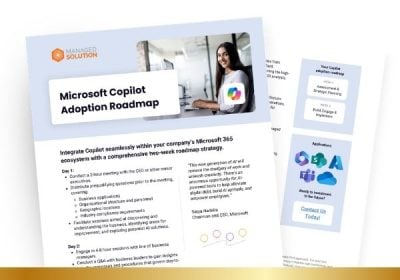
Whether your organization is exploring Microsoft Copilot for productivity, automation, collaboration, or operational efficiency, this roadmap helps establish the foundation needed for long-term AI success and measurable ROI.
Download the Microsoft Copilot Adoption Roadmap
If you’re ready to align powerful AI tools with your business objectives, improve adoption, reduce operational friction, and build a more measurable path toward AI ROI, download the roadmap today.
Final Thoughts: AI Success Depends on Measurable Operational Transformation
The organizations that see the greatest value from AI are not simply adopting new tools. They are building systems to measure how AI changes the way work happens across the business.
For AI ROI in 2026, successful measurement will increasingly depend on:
- Clear business objectives
- Clean and governed data
- Cross-functional adoption
- Workflow-level analytics
- Secure AI deployment
- Long-term operational planning
- Consistent KPI tracking
- Measurable business outcomes
Businesses that treat AI as a strategic operational initiative rather than a short-term experiment are far more likely to unlock sustainable value over time.
Additional Resources + Contact Us
If you’d like to dive deeper explore the resources below or request a live chat with one of our experts to get your questions answered directly about how to optimize AI and your business.
1. Understanding the Framework of Managed IT & AI Services
Visit our Managed IT Services Page
2. Explore Real, Measurable AI Success Stories
3. See our Microsoft Experts Deliver AI Demo’s
Microsoft Copilot Webinar Series
4. Articles for Insight on AI Solutions