


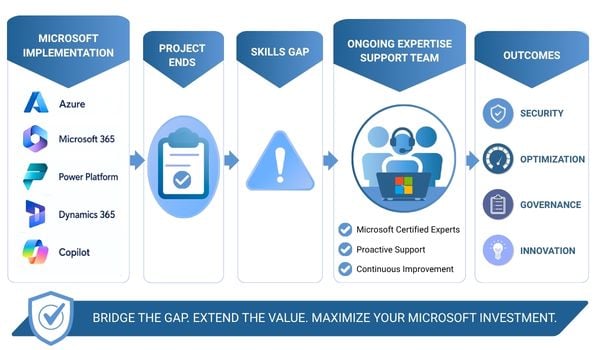
A Microsoft implementation may have a defined start and finish, but the need for specialized expertise rarely ends when the project does.
Whether an organization has migrated workloads to Azure, deployed Microsoft 365, built business applications with Power Platform, implemented Dynamics 365, or introduced AI with Microsoft Copilot, the post-project phase is where many businesses discover a familiar problem: Who is going to manage, optimize, secure, and continue developing what we just built?
For organizations with already-stretched IT teams, bringing in Microsoft expertise after a major project can be challenging. Hiring full-time specialists can take months, while letting critical knowledge walk out the door with a contractor can create its own set of risks.
The result is a Microsoft expertise staffing gap that can slow innovation, increase operational risk, and prevent organizations from getting the full value from their technology investments.
Table of Contents
The Microsoft Project Isn't Really Over
The traditional definition of a technology project is relatively straightforward: plan, implement, test, deploy, and hand off.
Modern Microsoft environments face many administrative and management hurdles that aren’t so simple.
A successful deployment creates an ongoing ecosystem that needs to evolve alongside the business to maximize the full potential and benefits. Azure environments require monitoring and optimization. Microsoft 365 environments need continual security and configuration management. Power Platform applications often need enhancements as business processes change. Dynamics 365 requires ongoing administration, development, and functional expertise.
Even after implementation, organizations may need specialists to:
- Optimize cloud infrastructure and spending
- Maintain security and identity configurations
- Develop new Power Apps and Power Automate workflows
- Manage Microsoft 365 and Intune environments
- Support Dynamics 365 applications
- Build and maintain integrations
- Govern Microsoft Copilot and other AI tools
- Document systems and transfer institutional knowledge
- Support compliance and audit requirements
- Identify opportunities for automation and process improvement
This creates a common post-project dilemma where the organization still needs specialized Microsoft skills, but it may not need a full-time employee for every role.
Why Microsoft Expertise Is Becoming Harder to Find
The challenge isn’t simply that organizations need more people. They need people with increasingly specialized combinations of technical and business expertise.
The World Economic Forum has reported that a significant portion of workers’ skills are expected to change or become outdated as technology continues to evolve, while employers consistently identify skills gaps as a major obstacle to transformation.
Microsoft’s ecosystem illustrates this challenge particularly well. Organizations may need expertise across Azure, Microsoft 365, Power Platform, Dynamics 365, cybersecurity, data, and AI, but finding someone who can work across those technologies while understanding the organization’s business requirements is considerably harder than filling a general IT position.
There is also intense competition for experienced technology professionals.
The four biggest challenges organizations face when hiring Microsoft developers and specialists tend to come down to scarcity, cost, and retention.
1. Scarcity
Experienced Microsoft professionals, particularly those with specialized certifications and real-world implementation experience, are in high demand, and this often leads to a more drawn-out hiring process than normal.
2. Cost
Senior Microsoft cloud architects, developers, and security engineers can command significant salaries. Hiring multiple specialists may not make financial sense when the workload fluctuates.
3. Retention
Even after investing significant time and resources into recruiting and onboarding an IT specialist, organizations have to compete with other employers for that person’s attention and expertise.
For businesses that only need Microsoft specializations for a defined period, traditional hiring can be an expensive and time-consuming solution.
The Microsoft Skills Gap Doesn't Stop at Developers
When organizations think about Microsoft staffing, they often focus on developers and engineers. But some of the hardest roles to fill sit at the intersection of technology and business.
Technical business analysts, Microsoft Consultants, and Microsoft Specialized Managed Services Providers are all good examples.
These professionals need to understand how Microsoft technologies work while also being able to translate business objectives into technical requirements. They help determine what the organization needs before architects and developers begin building the solution.
That combination of technical knowledge, business understanding, and communication skills is difficult to find.
The same applies to other specialized roles, including Azure architects and cloud engineers, Power BI specialists, and Copilot Studio developers to name a few.
As Microsoft environments become more interconnected, organizations increasingly need professionals who understand not just an individual product, but how multiple technologies work together.
Where Microsoft Skills Gaps Are Most Common
Certain areas of the Microsoft ecosystem consistently require specialized expertise.
Azure and Cloud Infrastructure
Azure environments need more than an initial migration plan. Organizations may need architects and engineers to optimize infrastructure, establish security baselines, manage workloads, improve performance, and control cloud costs.
Post-project support can also uncover opportunities to modernize legacy systems or redesign workloads that were migrated using a lift-and-shift approach.
Power Platform and Copilot
Power Platform can quickly expand beyond the original scope of implementation.
Once employees see what Power Apps, Power Automate, Power BI, and Copilot can do, demand for new applications, workflows, dashboards, and AI-powered solutions can grow rapidly.
That creates a need for professionals who can build new solutions while maintaining governance and preventing application sprawl.
Dynamics 365
Dynamics 365 environments often require both functional and technical expertise.
Organizations may need specialists who understand CRM or ERP processes as well as the underlying Microsoft technology. As business requirements change, those professionals can help modify workflows, integrations, reporting, and applications without disrupting critical operations.
Microsoft 365 and Security
Microsoft 365 is another environment that requires ongoing attention.
Identity, endpoint management, security policies, Teams, Intune, Entra ID, and Microsoft Defender all contribute to the organization’s broader security and productivity environment.
As threats evolve and Microsoft continues releasing new capabilities, internal teams may need additional expertise to keep pace.
Why Solving The Microsoft Expertise Staffing Gap Matters Post-Project
Bringing in Microsoft expertise after implementation isn’t simply about having another technical resource available. It can directly affect the long-term value and stability of the project.
Preserve Institutional Knowledge
A major implementation can involve months of architecture decisions, custom development, integrations, configurations, and troubleshooting.
When project resources leave immediately after deployment, internal teams can be left trying to understand why something was designed in a certain way or how a custom integration works.
A structured transition period with continued access to experienced specialists can help preserve that knowledge.
Maintain Governance and Compliance
For organizations operating in regulated environments, the post-project phase can be just as important as implementation.
Industries subject to requirements such as HIPAA, CMMC, or ITAR may need specialized professionals who understand both the Microsoft environment and the organization’s compliance obligations.
Ongoing expertise can help maintain appropriate configurations, documentation, access controls, and governance processes as the environment changes.
Continuous Optimization
Technology isn’t a set-it-and-forget-it investment.
After implementation, organizations often discover opportunities to automate manual processes, improve workflows, eliminate unnecessary costs, or integrate systems that weren’t part of the original project’s scope.
For example, a business might initially implement Microsoft Teams but later discover opportunities to connect collaboration workflows with platforms such as Workday, Jira, or its line-of-business applications.
Having access to Microsoft specialists makes it easier to turn those opportunities into practical improvements.
Reduce Project Risk
Continuity matters.
If a key consultant leaves immediately after implementation, the organization may lose valuable context at exactly the point when the internal team is taking ownership.
Working with a defined team or named consultants can create greater accountability and reduce the risk of repeatedly starting with new resources.
Three Ways to Close the Microsoft Expertise Gap
Organizations don’t necessarily need to solve every skills gap through traditional hiring.
Consider a Co-Managed IT Model
Not every organization needs to hand over its IT environment to an outside provider.
A co-managed model allows internal IT teams to retain ownership while an external partner supplements their capabilities.
That could mean bringing in Microsoft specialists for cloud projects, security initiatives, Power Platform development, Microsoft 365 administration, or other areas where internal resources are stretched.
Invest in Targeted Upskilling
External expertise shouldn’t replace internal development.
Organizations can use Microsoft’s training resources and learning pathways to identify opportunities to develop existing employees.
The goal isn’t necessarily to turn every IT professional into a Microsoft specialist. Instead, businesses can identify which capabilities are strategically important and build those skills internally while using external specialists to fill more advanced or immediate gaps.
When Post-Project Microsoft Expertise Is Most Important
Some organizations are more likely than others to benefit from ongoing Microsoft staffing support.
Regulated Industries
Healthcare, government, defense, financial services, and other regulated organizations often have stricter requirements around security, access, documentation, and data handling.
Maintaining specialized expertise can help ensure those requirements don’t become an afterthought once implementation is complete.
Large-Scale Transformations
A major Microsoft transformation doesn’t end at deployment.
Organizations undergoing broad cloud, workplace, data, or application modernization initiatives often need continued technical support to manage adoption, governance, optimization, and the next phase of their roadmap.
Integration-Heavy Environments
The more systems an organization needs to connect, the more important specialized expertise becomes.
Microsoft environments frequently interact with third-party applications, legacy platforms, databases, HR systems, financial systems, and business applications.
Those integrations need to be maintained and adapted as systems change.
Rapidly Evolving Technology Environments
Organizations adopting Copilot, AI agents, Power Platform, and other emerging technologies may find that their technology roadmap is moving faster than their internal hiring plans.
In these environments, flexible access to specialized expertise can help businesses experiment, implement, and scale without waiting for a lengthy recruiting process.
The End of the Project Is the Start of the Next Phase
A Microsoft project should not be considered truly complete when the implementation team leaves.
The real measure of success is whether the organization can continue operating, securing, optimizing, and building on what was implemented.
For some businesses, that means hiring permanent Microsoft specialists. For others, it means staff augmentation, a dedicated external team, or a co-managed model that works alongside internal IT.
The important thing is to plan for the post-project skills gap before it becomes a problem.
By identifying which Microsoft capabilities will be needed after deployment, organizations can protect institutional knowledge, maintain governance, accelerate innovation, and get more value from their technology investment.
Ready to Get More from Your Microsoft Environment?
Your Microsoft environment shouldn’t be something your IT team only has time to manage when an issue comes up. With Microsoft Consulting, you get dedicated senior Microsoft engineers who proactively plan, optimize, secure, and improve your environment throughout the year.
From roadmap planning and licensing optimization to ongoing engineering, security improvements, and Microsoft escalations, our team works alongside yours to keep your Microsoft environment moving forward.
Talk with a Microsoft expert today to see how we can support your team.