


Balancing Patient Care, Security, and Innovation
Resilient healthcare IT takes on a whole new meaning in today’s digital world. Healthcare CIOs face a unique challenge of keeping critical systems running 24/7 while advancing digital transformation initiatives that improve patient outcomes and operational efficiency. Unlike many industries, healthcare organizations cannot afford technology disruptions. Every system outage, cyberattack, or data accessibility issue has the potential to affect patient care, clinician productivity, and organizational revenue.
For many healthcare organizations, that challenge is compounded by limited internal IT resources, growing cybersecurity threats, increasing compliance requirements, and the need to support clinicians around the clock. As a result, many CIOs are turning to managed healthcare IT partners to extend internal teams, improve operational resilience, and accelerate modernization initiatives without adding unnecessary complexity.
In this article we’ll peel back the layers of the challenges technical leaders in healthcare face and highlight solutions and benefits of managed or co-managed IT support.
Table of Contents
Why IT Resilience Has Become a Strategic Priority
Healthcare environments are among the most complex IT ecosystems in any industry. Electronic health records (EHRs), clinical applications, medical devices, imaging systems, billing platforms, and communication tools must work seamlessly together to support patient care.
When even one of these systems becomes unavailable, the impact extends far beyond IT.
A network outage can delay treatment decisions. An unavailable EHR can disrupt access to patient histories and medications. A cybersecurity incident can prevent clinicians from accessing critical information when they need it most.
As healthcare organizations continue expanding digital capabilities, building a resilient IT environment has become a strategic business objective rather than a purely technical initiative.
Uptime Is Essential to Delivering Quality Patient Care
Healthcare operates around the clock. Patients expect uninterrupted access to care, and clinical teams depend on reliable technology to deliver it.
Maintaining uptime requires more than reactive support and instead need an infrastructure designed to minimize service disruptions before they occur.
Key considerations for healthcare IT leaders include:
- Ensuring continuous availability of EHR and clinical systems
- Monitoring network performance across facilities and care settings
- Reducing unplanned downtime through proactive maintenance
- Establishing escalation procedures for critical incidents
- Providing around-the-clock support for mission-critical environments
This makes access to consistent monitoring, rapid issue resolution, and specialized expertise across infrastructure, networks, cloud environments, and clinical applications a massive priority. For Healthcare organizations with limited IT staff, this is where they can rely on managed IT services to provide the 24/7 support and proactive management that helps prevent issues before they affect patient care.
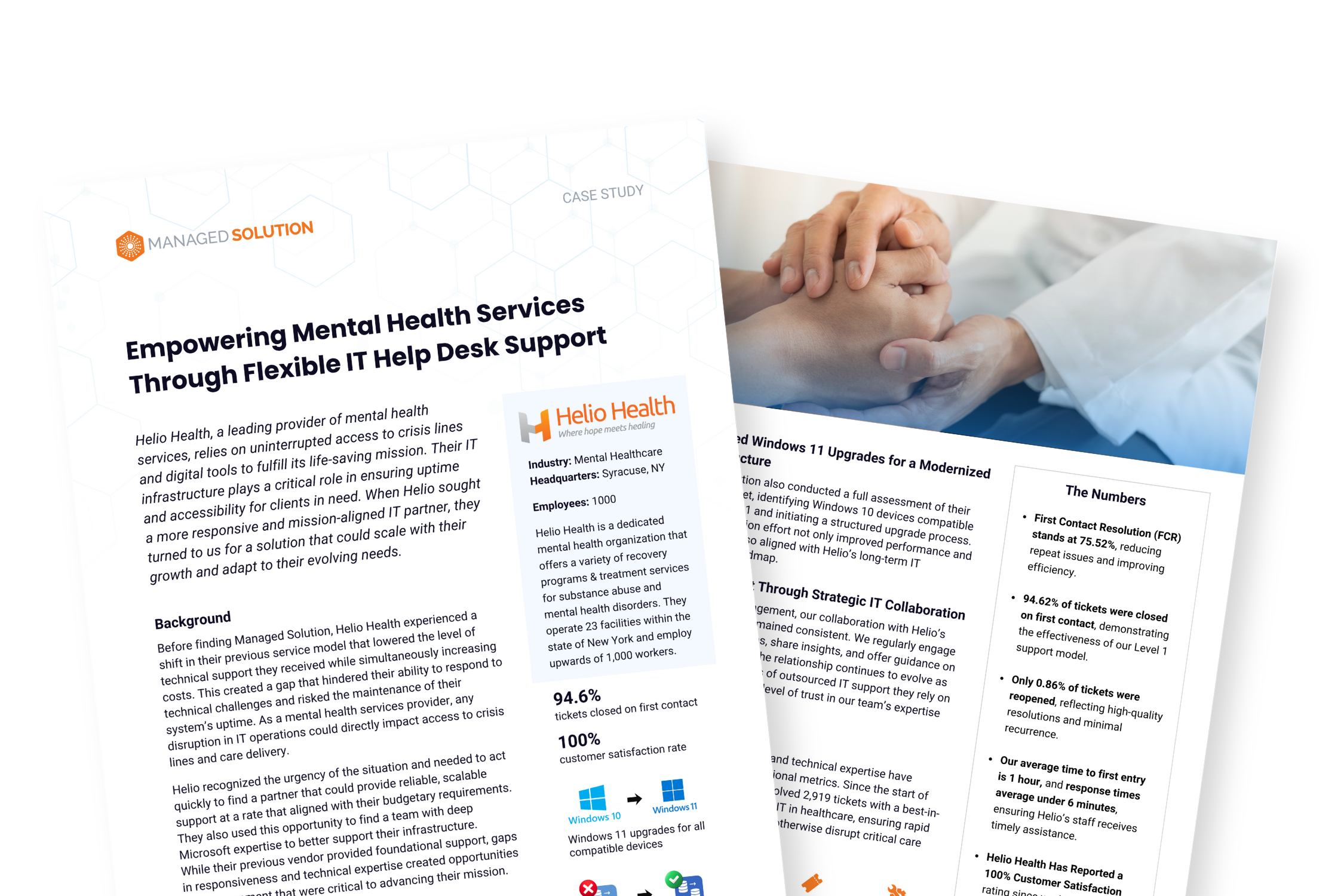
Healthcare Client Success Story
A great example of this comes from one of our very own client success stories with Helio Health. We worked with them to create a flexible contract that enabled them to ensure they had the support they needed to maintain uptime and patient access to care.
Healthcare Disaster Recovery Means Keeping Care Moving
Healthcare leaders know that downtime is never just an IT issue. When critical systems become unavailable, clinicians can lose access to patient information, workflows slow down, and care delivery is disrupted.
That’s why disaster recovery has become a core component of operational resilience. The most prepared organizations don’t just focus on restoring data. They invest in backup, disaster recovery, and business continuity solutions that help keep critical systems available and recover quickly when disruptions occur.
By combining proactive planning with modern backup and disaster recovery solutions, and managed recovery services, healthcare organizations can accelerate restoration efforts, protect critical patient data, and maintain operational continuity when unexpected disruptions occur.
Strengthening Cybersecurity Without Slowing Innovation
Healthcare remains one of the most targeted industries for cybercrime, driven by the high value of patient data and the mission-critical nature of clinical operations. At the same time, organizations are accelerating digital transformation efforts through cloud adoption, connected medical devices, remote work capabilities, telehealth platforms, and patient-facing digital services. While these technologies create new opportunities to improve care delivery and operational efficiency, they also expand the attack surface and introduce new risks.
Building a resilient healthcare IT environment requires more than deploying security tools. It demands a comprehensive approach that protects endpoints and connected devices, monitors network activity, strengthens identity and access controls, equips employees to recognize threats, and enables rapid detection and response when incidents occur. Just as importantly, healthcare organizations must ensure their security strategies support regulatory compliance and audit readiness.
Investing in managed cybersecurity services that provide continuous monitoring, vulnerability management, identity protection, incident response, and compliance support allows internal teams to focus on strategic initiatives while maintaining a stronger security posture.
Regulatory Shifts in Healthcare IT Compliance
Healthcare IT leaders must also navigate a continuously changing regulatory landscape. Recent developments, including the FTC’s lawsuit against Hims & Hers over patient data-sharing practices, the FTC’s investigation into Epic Systems’ interoperability and data access policies, and new CMS telehealth reimbursement initiatives, highlight the growing focus on healthcare data governance, transparency, and digital health oversight.
These developments reinforce the importance of working with technology partners who understand the unique intersection of healthcare operations, cybersecurity, compliance, EHR systems, telehealth platforms, and evolving regulatory requirements.
Modernizing Legacy Systems for Long-Term Success
Many healthcare organizations operate complex environments built on decades of technology investments. Legacy systems often support critical functions, making modernization challenging.
However, continuing to maintain aging infrastructure can increase costs, create inefficiencies, and limit an organization’s ability to adopt new technologies.
Healthcare CIOs are increasingly focused on creating a modernization roadmap that balances operational stability with innovation.
This may include:
- Consolidating disparate systems
- Migrating infrastructure to the cloud
- Improving interoperability between applications
- Automating manual workflows
- Standardizing technology platforms
- Enhancing collaboration tools
Successful modernization programs take a phased approach that minimizes disruption while delivering measurable improvements in performance, security, and operational efficiency.
Whether migrating infrastructure to the cloud, integrating newly acquired facilities, modernizing legacy applications, or standardizing collaboration platforms, many healthcare organizations benefit from experienced technology partners who can help execute modernization efforts while minimizing operational risk.
Building a Data Strategy That Drives Better Decisions
Healthcare organizations generate enormous volumes of data, yet many struggle to turn that information into actionable insights.
Data often remains trapped in disconnected applications and departmental silos, limiting visibility into clinical, financial, and operational performance.
A modern data strategy helps healthcare leaders answer critical questions:
- How can we improve patient flow?
- Where are operational bottlenecks occurring?
- How can staffing and resource allocation be optimized?
- Which processes are impacting revenue cycle performance?
- What trends are influencing patient outcomes?
By integrating data sources and implementing business intelligence solutions, organizations can gain a more complete view of their operations and make faster, evidence-based decisions.
Equally important is ensuring clinicians and staff have secure, compliant access to that information wherever care is delivered. Modern healthcare IT environments must support interoperability, secure EHR access, and real-time collaboration across departments, facilities, and care settings.
The result is improved efficiency, greater visibility, and stronger alignment between organizational goals and patient care objectives.
The Future of Healthcare IT Requires Balance
Healthcare CIOs must navigate competing priorities every day. They are expected to improve patient experiences, strengthen security, maintain compliance, control costs, and accelerate innovation, all while ensuring systems remain available when patients and providers need them most.
Building a resilient healthcare IT environment requires balancing five critical pillars:
- Continuous uptime and operational availability
- Comprehensive disaster recovery and business continuity
- Strong cybersecurity and compliance practices
- Strategic modernization of legacy systems
- Data-driven decision-making and analytics
Organizations that successfully align these priorities will be better positioned to support clinicians, protect patients, and adapt to the evolving healthcare landscape.
Conclusion
Resilience has become the foundation of modern healthcare IT. By investing in secure, highly available infrastructure, robust recovery capabilities, modernization initiatives, and data-driven operations, healthcare organizations can reduce risk while creating a technology environment that supports both patient care and future innovation.
For healthcare leaders, the objective is clear: build an IT ecosystem that is resilient enough to withstand disruption and agile enough to enable what’s next. Achieving that balance often requires a combination of internal expertise, trusted technology partners, and a proactive approach to security, compliance, modernization, and operational support.
Build a More Resilient Healthcare IT Environment
From cybersecurity and compliance to cloud modernization, disaster recovery, and 24/7 support, healthcare organizations need technology strategies that protect patient care while enabling innovation.

Download our Managed IT Services for Healthcare Datasheet
Learn how healthcare providers are strengthening security, improving uptime, supporting EHR environments, and reducing operational risk with a managed services approach.