


Managed IT Services pricing can feel confusing, inconsistent, or even arbitrary. Two companies of similar size can receive wildly different quotes, while pricing models like “per user,” “per device,” or “per ticket” often raise more questions than they answer.
To have MSP pricing models explained best for decision makers, it’s important to note that better pricing doesn’t just boil down to the model itself. Rather, the time, demand, and access to data visibility of the services rendered. These are the factors that help managed service providers understand exactly what it will take to support the businesses they serve.
In other words, understanding how MSP pricing works means understanding what drives it. Continue reading to dive deeper into choosing the right model, avoiding billing surprises, and building an IT budget that actually scales with your business.
Table Of Contents
- What is an MSP?
- 4 MSP pricing model examples
- What affects the pricing of managed services?
- What is the Best MSP pricing model for your business?
- Data-driven savings: Power BI & Managed Services
- Transparent Billing With Managed Solution
- MSP pricing mistakes and solutions
- Final Thoughts + Pricing Calculator
What Is an MSP?
- Help desk and end‑user support
- Security and compliance
- Network and infrastructure management
- Cloud services and identity management
- Monitoring, patching, and maintenance
4 Key MSP Pricing Model Examples
There are four primary pricing models used across the managed services industry. Each attempts to translate unknown demand into predictable cost.
1. Price‑Per‑User Model
This model charges a flat monthly fee for each employee supported.
Why businesses like it
- Simple to understand
- Easy to budget
- Works well for stable, predictable workforces
Where it breaks down
- Not all users generate the same support demand
- Rapid hiring, layoffs, or seasonal work can distort cost
- Assumes consistent user behavior month over month
2. Price‑Per‑Device Model
Pricing is based on the number of managed devices such as laptops, desktops, or servers.
When it works best
- Environments where devices are shared
- Industries like healthcare or manufacturing
- Scenarios where device count matters more than headcount
The limitation
- Devices don’t submit tickets, people do
- User behavior still drives most help desk demand
3. Ticket Retainer Model
Customers purchase a monthly allowance of support tickets, often paired with assumptions about how long each ticket takes to resolve.
What’s Appealing to Customers
- Simple and easy to understand
- Tends to set contracts at lower price points
The challenge
- Ticket volume alone doesn’t equal effort
- A “ticket” could take 5 minutes or 60 minutes
- Without knowing the average time per ticket, costs become unpredictable
This model often leads to overages, frustration, and billing conversations driven by assumptions instead of data.
4. Time‑Based / Hourly Retainer Model
Customers purchase a set number of support hours each month.
Why MSPs use it
- Works when ticket data is unavailable
- Increases flexibility for issue resolution and client budgets
- Ties cost directly to effort
Why customers hesitate
- Feels like modernized break/fix
- Raises concerns about burn rate
Requires trust and transparency to work well
What Affects the Pricing of Managed Services?
Regardless of the pricing model, MSP costs are driven by the same underlying factors:
- Number of users
- Ticket volume per month
- Average time to resolve each ticket
- Complexity of the environment
- Internal IT team involvement (co‑managed vs fully managed)
Most MSPs ask for ticket history, analytics, and user data during pricing. However, most companies can only provide raw exports, not actionable insight. Without clear data, pricing becomes an educated estimate.

What Is the Best MSP Pricing Model for Your Business?
- They use real operational data
- They establish a clear baseline
- They allow flexibility as the business changes
- How many users need support
- How often they need it
- How long support takes
Data Driven Savings: Power BI & Managed Services
- Top ticket categories
- Recurring issues
- Time spent per request
- Support trends over time
- Identify why ticket volume is high
- Reduce unnecessary support demand
- Eliminate recurring issues through better technology or training
- Forecast future costs instead of reacting to them
How Managed Solution Delivers Transparency
At Managed Solution, we set ourselves apart by delivering Power BI reporting as part of our managed service offering. Rather than customers relying on static reports or opaque invoices, we provide real‑time visibility into support activity, trends, and value delivered.
By combining managed services with data‑driven reporting, Managed Solution empowers customers to make informed decisions, optimize their environments, and plan confidently, knowing exactly where their IT investment is going and how it’s driving measurable results.
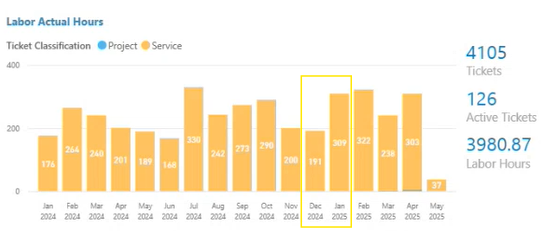
Want to see how this works in practice?
Dive into how Power BI transforms help desk data into real‑time insights with a real use-case of smarter decisions and better outcomes driven by data reporting. Read the full Power BI IT Ticket Analysis blog to see how transparency and reporting elevate the MSP experience.MSP Pricing Mistakes & Solutions
| MSP Pricing Mistakes and Solutions | |
|---|---|
| Mistake | Solution |
| Choosing pricing based on simplicity alone | Choose pricing backed by data, not assumptions. |
| Ignoring ticket complexity | Track time per ticket, not just volume. |
| Treating overages as failures | Use overages as signals that something in the environment changed. |
| Static pricing in a dynamic business | Build pricing models that scale up and down with demand. |
Final Thoughts + Managed Services Pricing Calculator
As businesses grow, contract, and adapt, IT support demand follows. The future of managed services pricing isn’t just about picking the “right” model, but moreover ensuring data visibility is accessible in order make IT support costs fair, flexible, and predictable.
Want to learn more about working with Managed Solution and our data‑driven approach to transparent billing? Contact us here. You deserve real‑time insight into your support, not billing surprises.