


Should you go with Microsoft Enterprise Agreement (EA) or with a Cloud Solution Provider (CSP)? Making the right choice is critical in business, but determining the best decision for your specific organization can be challenging.
For years, large enterprises relied on the Microsoft EA for predictable pricing and volume discounts. But starting November 2025, Microsoft is phasing out tiered EA discounts and moving to flat list pricing for online services like Microsoft 365, Azure, and Dynamics 365. Organizations with fewer than 2,400 seats are no longer prioritized for EA renewals, and many mid-market businesses are being directed toward CSP.
So what does this mean for you? In this guide, we’ll break down Microsoft CSP vs EA and help you decide which model best aligns with your business goals in 2025 and beyond.
Table of Contents
- Microsoft CSP vs EA
- Comparison Chart + Downloadable Data Sheet
- What Can a CSP Partner Provide?
- Which CSP Partner Should You Select?
- Why Choose Managed Solution?
- Conclusion
Microsoft CSP vs EA – Which One is for You?
Deciding between a Microsoft Enterprise Agreement (EA) and the Cloud Solution Provider (CSP) program depends on your organization’s goals and flexibility needs.
Microsoft Cloud Service Provider (CSP)
The CSP model offers flexibility and scalability, making it ideal for organizations that need agility in their licensing strategy. Unlike EA, CSP licensing has no minimum seat requirement, and you can choose monthly, annual, or even three-year subscription terms. This is perfect for businesses that experience seasonal workforce changes or operate in volatile markets.
Key benefits of CSP:
- Flexible commitment terms: Choose monthly, annual, or 3-year subscriptions based on your needs
- No minimum user requirements: Accessible to organizations of all sizes (unlike EA’s 2,400+ user target)
- Scale up anytime: Add licenses immediately as your business grows
- Scale down at term end: Reduce licenses at the end of each billing period (monthly or annual commitments)
- Partner-led support: Comprehensive advisory services, cost optimization, and implementation guidance
- Same Microsoft cloud products as EA (Microsoft 365, Azure, Dynamics 365) without rigid multi-year commitments
- No large upfront costs: Pay-as-you-go billing for better cash flow management
Understanding CSP Flexibility:
CSP offers two primary commitment options to match your business needs:
- Monthly subscriptions: True month-to-month flexibility with the ability to scale licenses up or down each month. Ideal for seasonal workforces or rapidly changing businesses. Priced approximately 20% higher than annual commitments for the added flexibility.
- Annual subscriptions: Lower per-seat pricing with the ability to add licenses anytime. License reductions are only available at the annual renewal. Perfect for organizations with stable baseline staffing.
- Best practice: Combine annual subscriptions for your core workforce with monthly subscriptions for variable needs, maximizing cost savings and flexibility.
Microsoft Enterprise Agreement (EA)
Microsoft EA is now primarily targeted at very large organizations (2,400+ seats) that need enterprise-wide standardization and value long-term price protection. However, EA’s advantages have significantly diminished in 2025.
Major EA Changes Effective November 2025:
- Volume discounts eliminated: Microsoft removed all tiered discounts (Levels A–D) for online services. All customers now pay flat list pricing regardless of size.
- Price increases: Organizations that previously had Level B–D discounts face 6–12% cost increases at renewal
- Reduced accessibility: Microsoft is no longer offering EA renewals to organizations with fewer than ~2,400 seats
EA still makes sense if:
- You have 2,400+ seats and want a single, centralized contract for all Microsoft products
- You value price protection for three years and can commit to a fixed term
- You need enterprise-wide standardization and Software Assurance benefits (like hybrid use rights for on-premises servers)
However, EA requires:
- A three-year commitment with annual payments or upfront billing
- Limited flexibility: Can only add licenses mid-term; reductions only allowed at annual anniversary
- Risk of overprovisioning: Annual true ups can lead to paying for unused licenses
Bottom Line For Enterprises
If your organization wants predictable monthly billing, the ability to adjust consumption dynamically, and avoid large upfront costs, CSP is the better fit. EA still works for very large enterprises (2,400+ seats) with stable license counts and long-term planning needs, but its advantages are shrinking as Microsoft moves toward cloud-first, consumption-based models.
Bottom Line For SMBs
For small and mid-sized businesses, partnering with a Cloud Services Provider is almost always the best choice. It offers no minimum commitment, flexible billing, and partner-driven support, making it easier to align licensing with actual usage and budget constraints.
Microsoft EA vs CSP Comparison Chart and Data Sheet
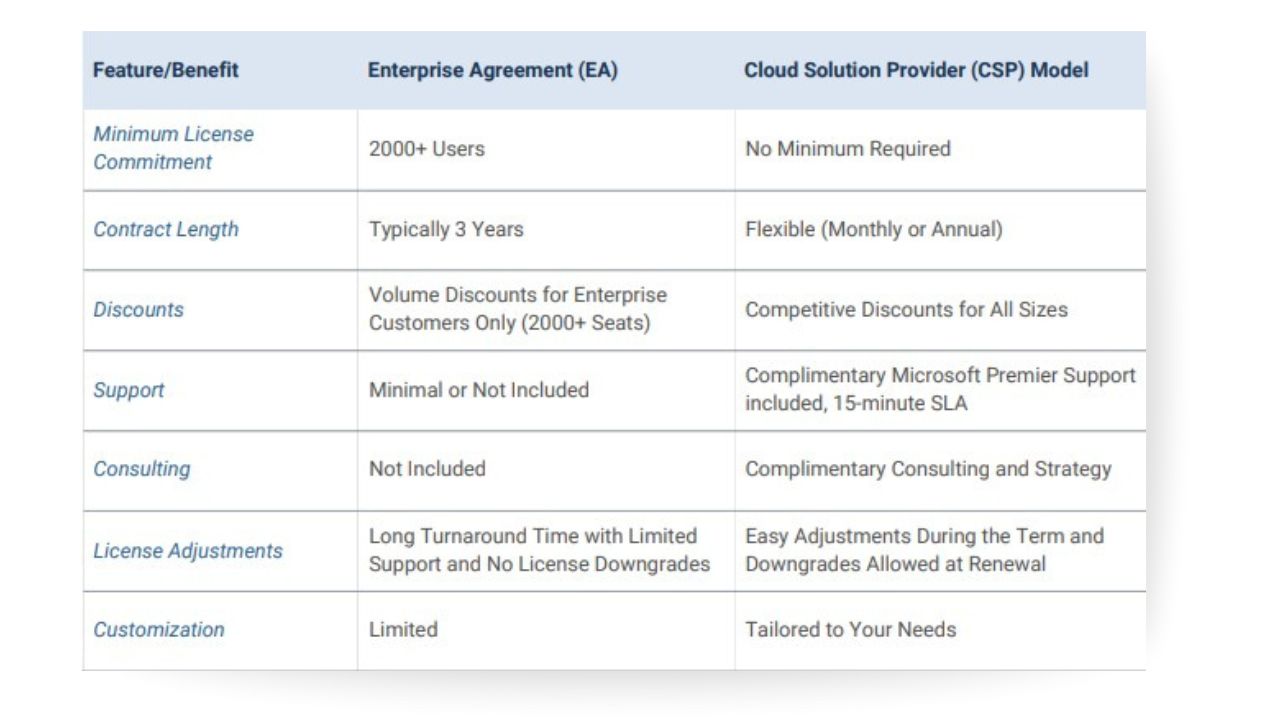
Compare in-depth with our comprehensive Microsoft CSP vs EA Data Sheet
What Can a CSP Partner Provide?
The Microsoft CSP model connects you with a certified Microsoft Solutions Partner who acts as a trusted tech advisor. The right Microsoft Partner will create a foundational relationship with your team to help you choose the right services, manage licensing, and provide end-to-end support. This consultative approach ensures flexibility and maximizes the value of your Microsoft investment.
Key Benefits
- Pay only for what you use – Avoid overpaying for unused licenses and align costs directly with actual consumption.
- Flexible billing and scalability – Choose monthly, annual, or multi-year terms and easily scale up or down at term renewal.
- Expert support and training – Gain access to certified Microsoft partners who provide guidance, troubleshooting, and user adoption strategies.
- Simplified license management – Streamline renewals, adjustments, and compliance through a single partner-managed platform.
Which CSP Partner Should You Select?
When selecting a Microsoft Cloud Solution Provider, you’ll encounter two main models: Direct Providers and Indirect Resellers. Both offer unique advantages depending on your organization’s needs and resources.
CSP Direct Providers
Direct Providers operate in a single-tier model, meaning they have a direct contractual relationship with Microsoft. They handle billing, support, and customer lifecycle management end-to-end. This model is ideal for organizations seeking a partner with deep technical expertise and robust infrastructure for implementation and ongoing support.
Key Characteristics:
- Direct billing and support from the partner
- Full control over pricing and service bundling
- Premier-level support access and direct Microsoft relationship
- Greater accountability and faster response times
CSP Indirect Resellers
Indirect Resellers operate in a two-tier model, relying on a distributor for billing, technical resources, and support. While this approach reduces operational complexity, it also means less direct control over pricing, service delivery, and response times, which can lead to dependency on the distributor’s processes.
Key Characteristics:
- Access to distributor-provided tools, training, and support
- Flexible entry point to CSP
- May have longer resolution times due to additional layer
Why Choose Managed Solution?
At Managed Solution, we make Microsoft licensing simple, cost-effective, and tailored to your business. As a Certified Microsoft Solutions Partner with direct Premier support access, we deliver best-in-class pricing, 24/7 assistance, and expert guidance on Microsoft 365, Azure, and cloud solutions.
Our flexible CSP model means you pay only for what you need, avoid large upfront costs, and scale effortlessly as your business grows. From consultation to ongoing management, we handle more complex details so you can focus on innovation and business outcomes.
What sets us apart:
- Microsoft Premier Support Included – Unlike most CSP providers, we include Microsoft Premier support with your subscriptions at no additional cost, giving you access to enterprise-grade technical assistance
- 30-Minute Response – Our dedicated cloud support team responds to all CSP customer inquiries in under 30 minutes during business hours
- 100% US-Based Support Team – Work directly with experienced Microsoft professionals based in the United States who understand your business needs
- Best-in-Class Pricing – Competitive rates on Microsoft 365, Azure, and Dynamics 365 without sacrificing service quality
- 24/7 Proactive Monitoring – Round-the-clock oversight of your Microsoft environment to identify and resolve issues before they impact your business
- Expert Guidance – Strategic consultation on licensing optimization, cloud migrations, and Microsoft best practices
Final Thoughts
Microsoft licensing is evolving. With EA becoming less flexible and more expensive for many organizations, CSP provides a modern, agile alternative that aligns with today’s cloud-first business environment. Before your next renewal, reassess your licensing strategy to ensure your business is set up to maximize its ROI with the Microsoft Solutions your business relies on.
As a Specialized Microsoft Solutions Partner (ranked among the top 150 in the US), Managed Solution is proud to be a Certified digital advisor for mid-market and enterprise businesses across a variety of industries, including as biotech, legal, finance and healthcare.
To get personalized support in determining the right option for you, or explore additional licensing options & their benefits, chat with one of our experts.