


The role of CFOs in M&A (mergers and acquisitions) is critical to successful and profitable outcomes, which is why they’re often the natural executive to lead M&A efforts at the board level.
M&A activity has been accelerated since the COVID-19 pandemic and technological advancement leading to ongoing business transformation. However, according to research by Deloitte, less than 40% of M&A transactions create shareholder value. The most common reasons for failure are poor integration execution and overpaying for acquisitions.
Further research shows that companies that consistently succeed in M&A tend to have CFOs deeply involved throughout the entire process, not just in financial or technical tasks. With appropriate support and delegation, active CFO involvement strengthens discipline, objectivity, and value realization.
Today, we’ll clarify the technical and financial aspects of M&A and break down how the Chief financial officer job role, when strategically intersected with IT, can enable fruitful outcomes for businesses everywhere.
Table of Contents
What is the Modern Role of CFOs in M&A?
For Mergers and Acquisitions, CFO job responsibilities align as they bring expertise of financial operations, as well as a disciplined and data-driven lens that gives their businesses more control over valuation, financing, and ensures due diligence.
Because M&A impacts the entire organization, the CFO often acts as the “firm hand” of the executive board to provide strategic alignment. Increasingly, that responsibility extends beyond finance and into the technical dimensions of integration, where misalignment, uncertainty, or execution gaps can quickly erode deal value.
As Deloitte Observes:
"At the other end of the spectrum are CFOs with an increased focus on the more technical elements of the M&A process, thus letting the rest of the Executive Board take care of everything else, including the overall responsibility."
Successful M&A therein requires close partnership between the CFO and IT leadership to ensure technology decisions stay aligned with the deal strategy, financial goals, and timeline. By working together early, CFOs and IT teams can identify integration priorities, manage risk, and create a clear roadmap for unifying systems without disrupting the business.
However, as integration complexity and timelines intensify, even well aligned internal teams can become stretched. Delegating the technical facets of M&A to a trusted third party is one strategy that counteracts this challenge by allowing CFOs to extend critical support to their technical teams without overloading internal resources.
By offloading execution-heavy integration work such as infrastructure assessment, data and identity migration, security alignment, and platform consolidation, CFOs can bridge the gap between strategic intent and technical reality.
Team augmentation can also extend to the financial side of things, as many organizations are increasingly relying on a fractional chief financial officer to guide complex transactions without the cost or commitment of a full‑time executive.
A fractional CFO brings senior‑level financial leadership, deal experience, and objective oversight to critical moments such as valuation, due diligence, and integration planning. This model is especially valuable for small to mid‑market companies pursuing growth through M&A, as it enables disciplined financial governance and strategic alignment throughout the transaction lifecycle.
These are both powerful options for CFOs and IT leadership to consider when strategizing for strengthened structure, clarity, and more predictable processes in M&A endeavors.
Where CFOs Add the Most Value
CFOs are especially well suited to:
- Evaluate acquisition targets objectively
- Negotiate price and deal structure
- Lead with due diligence
- Secure necessary financing and resources
- Ensure post-deal value realization during integration
For large, transformative acquisitions, CFO involvement in integration planning and execution is essential to capturing synergies and avoiding value leakage.
What Does M&A Mean in IT Terms?
From an IT standpoint, a merger or acquisition is the process of combining two separate technology environments into one that supports the newly formed business.
Each company brings its own:
- Systems
- Data
- Users
- Security rules
- Infrastructure
- Vendors and licenses
IT’s job is to make all that work together so employees can keep working, customers aren’t impacted, and the business can scale.
Where IT Impacts The CFOs Objectives for M&A
While business leaders oversee strategy, market share and financial performance for M&A, IT functions to maintain operational continuity, user productivity, security & compliance during transition. Furthermore, IT is a critical department to focus on during M&A projects for cost efficiency.
If IT doesn’t have the right support, technology mergers and acquisitions can lead to issues with employee login access, broken email systems, lost or duplicated data, vulnerabilities from security gaps and, of course, superfluous spending on technology assets and/or services.
Mergers and acquisitions should lead to profitable outcomes for the parties involved, but these kinds of issues can negatively impact the desired ROI which is exactly why it is so important for the CFOs role in M&A to intersect with IT operations.
Common Challenges of M&A
Mergers and Acquisitions (M&As) present numerous challenges for Chief Financial Officers and Technical teams alike and understanding both sides of this can help to better bridge the gap for more successful outcomes.
Challenges CFOs Face with M&A Deals
- Limited visibility into technology costs and liabilities
- Difficulty forecasting post‑merger IT run‑rate
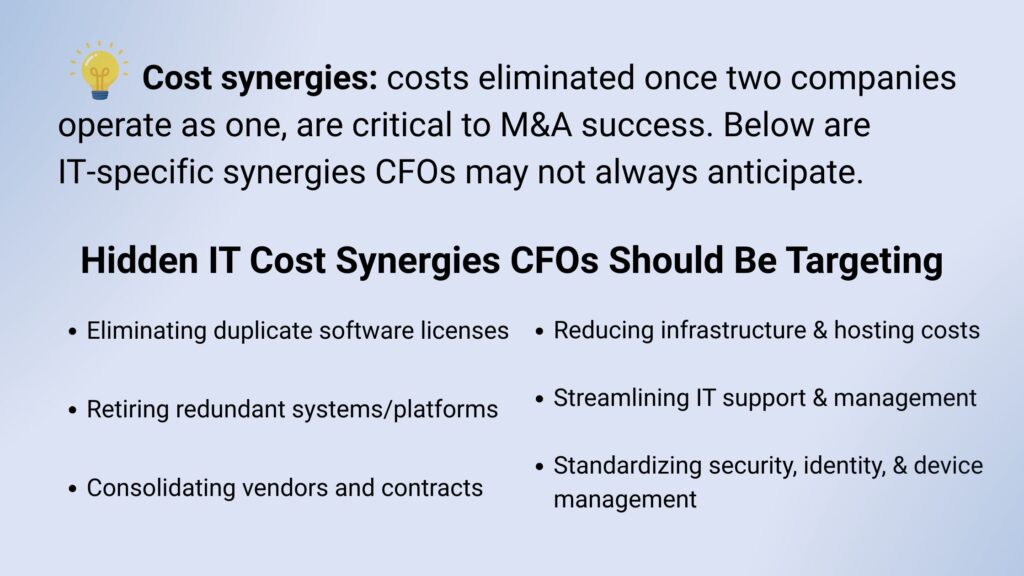
- Pressure to quickly identify cost synergies
- Managing risk while maintaining business continuity
- Keeping integration aligned with deal timelines and financial objectives
Technical Challenges of M&A
- Integrating disparate systems, platforms, and data
- Managing duplicate tools, licenses, and vendors
- Securing identities and access across organizations
- Supporting end users during periods of rapid change
- Executing migrations without disrupting daily operations
Despite these challenges, there is a clear path forward to achieve success in M&A.
When CFOs and IT teams align early, many of these challenges become manageable. A structured, well-defined approach helps bridge strategy and delivery, bringing clarity to complex integrations while reducing risk, controlling costs, and accelerating time to value. With the right support, organizations can move through M&A with confidence to emerge stronger, unified, and ready to scale.
How Managed Solution empowers CFOs during M&A
At Managed Solution, we design our M&A services to give CFOs clarity, control, and confidence throughout the process to accelerate integration while minimizing financial, operational, and compliance risk.
Phase 1: Assessment
Before any data moves, we conduct a comprehensive assessment of both organizations’ environments to ensure migration feasibility, cost efficiency, and long‑term scalability. This phase supports CFOs by providing early visibility into risk, complexity, and hidden liabilities that can impact deal value.
We work with you to:
- Define user end goals and establish the key stakeholders
- Map out your current infrastructure
- Pinpoint gaps
Identify obstacles, bottlenecks and liabilities
Phase 2: Migration
Once the integration strategy is defined, we execute a structured migration driven by powerful tools and deep expertise. This process is designed to compress timelines, reduce disruption, and unlock synergies faster.
Using proven migration technologies and automation, we:
- Execute a controlled moving day for migrating the majority of company data quickly and securely
- Finalize reconfiguration of remaining components, including end-user devices and access controls
- Consolidate services to simplify management, improve visibility, and reduce ongoing operating costs
Key consolidation areas often include:
- Entra ID (Formerly known as Azure Active Directory)
- Office 365 and calendaring systems
- Identity federation, multi-factor authentication, and single sign-on (SSO)
- Endpoint and mobile device management
- Security, patching, and update policies
For CFOs, this phase directly supports measurable cost savings, improved governance and financial oversight across entities. We help reduce ongoing cost to operate IT through platform rationalization (reducing multiple overlapping technology platforms into a smaller, standardized set), and we lower integration risk by leveraging our deep experience and expertise to implement at a controlled, objective-oriented speed.
Phase 3: End User Support
Post-migration, we ensure the organization captures the full value of the new environment well beyond the technical integration.
We support this phase by:
- Providing end-user documentation and training to minimize productivity downtime
- Supporting change management to accelerate user adoption
- Offering ongoing managed services to optimize performance, security, and cost efficiency
For CFOs, this translates to sustained operational stability post-close, predictable IT spend and reduced support burden, stronger ROI on cloud and M&A investments, and the confidence that the combined organization is secure, compliant, and scalable.
Want to Learn More About M&A Services with Managed Solution?
Three Key Takeaways for CFOs
- Take a Leading Role
CFOs should assume primary responsibility for M&A governance, ensuring the organization has the right processes, skills, and controls before pursuing deals. - Focus on Value and Maintain Control
Prevent “deal fever,” overpayment, strategic misalignment, or taking on acquisitions beyond the company’s capacity to integrate effectively. - Act as an Integration Catalyst
In larger transactions, CFOs should actively support integration by tracking value creation, pricing, cost synergies, and back-office efficiencies.
M&A success is far more likely when CFOs are actively involved end-to-end. Bridging the gap with technical departments enables them to bring discipline, financial clarity, and integration focus to ensure deals create real, lasting value.