


IT problems rarely happen at convenient times. A server issue at midnight, a locked user account during a weekend shift, or a Microsoft Windows support request after business hours can quickly slow operations and frustrate employees. That is why more businesses are investing in after hours help desk services and looking for flexible MSP pricing models that can scale with their needs.
Modern managed service providers are moving away from rigid contracts and offering more adaptable solutions that align with how companies actually use IT support. Whether you are a startup trying to control costs or an established organization managing growth, scalable IT support can help you stay productive without overspending.
This guide explains how managed IT service desk providers structure pricing, what Tier 1, Tier 2, and Tier 3 IT support actually mean, and how IT ticketing systems support flexible billing models.
Table of Contents
- Why After Hours IT Support Matters
- What Is a Managed IT Service Desk?
- What Are Common Flexible Pricing Models Used by Managed Service Providers?
- Benefits of Scalable Managed IT Costs for Businesses
- Questions to Ask About Customizable MSP Packages
- Real World Example: Flexible After Hours Help Desk Support in Action
- Final Thoughts: Choosing the Right After Hours Help Desk Provider
Why After Hours IT Support Matters
Businesses no longer operate strictly from 9 to 5. Remote teams, hybrid work, global customers, and cloud platforms have created an environment where downtime at any hour can impact productivity and revenue.
After‑hours help desk services ensure your business stays operational at all times by providing technical support during evenings, weekends, and holidays when internal IT teams may be unavailable. These services help businesses respond quickly to issues like:
- Login and password problems
- Connectivity issues
- Microsoft Windows support requests
- Application outages
- Device troubleshooting
- Cloud and Microsoft 365 support issues
For many organizations, after hours IT help desk support is now considered a critical part of business continuity planning. A reliable managed IT service desk helps businesses maintain uptime, reduce disruptions, and improve the employee experience regardless of the time of day.
What Is a Managed IT Service Desk?
Many businesses use the terms help desk and service desk interchangeably, but they are not exactly the same.
IT Help Desk Services
A traditional IT help desk focuses on resolving end-user technical issues quickly. This often includes:
- Password resets
- Device troubleshooting
- User support requests
- Ticket management
- Basic software support
This level of support is commonly referred to as Tier 1 help desk support.
Managed IT Service Desk Solutions
A managed IT service desk provides broader operational support and strategic oversight. In addition to handling tickets, service desk solutions often include:
- Broader ITIL‑based management
- Incident, problem, and change management
- Integration with Microsoft Windows support and cloud tools
- Strategic oversight in managed IT service desk offerings
Businesses searching for “IT support near me”, often benefit from combining both help desk services and service desk solutions under a single MSP with scalable, remote, 24/7/365 coverage.
What Are Common Flexible Pricing Models Used by Managed Service Providers?
1. Tiered Pricing Structures
Tiered pricing bundles services into levels (Basic, Standard, Premium). How tiered pricing structures work for managed IT services:- What Does Tier 1 Support Mean?
- Lower tiers focus on Tier 1 help desk and basic ticketing
- What does Tier 2 msp support mean?
- Mid tiers add managed IT service desk coverage and monitoring
- What does Tier 3 msp support mean?
- Top tiers include after hours support, Windows 365 support, and proactive maintenance
2. Pay‑As‑You‑Go Pricing Plans
Many companies ask us: Which MSPs offer pay‑as‑you‑go pricing plans for scaling a small/medium business support? In pay‑as‑you‑go models:- You pay per ticket, per hour, or per incident
- Ideal for startups or seasonal businesses
- Costs scale with actual usage
3. Customizable Monthly Pricing Options
Custom MSP packages allow businesses to pick services à la carte:- After‑hours help desk only
- Ticketing system access without full management
- Microsoft Windows support without hardware management
Benefits of Scalable Managed IT Costs for Businesses
Scalable pricing means your IT support grows with your business rather than ahead of it.
Key benefits include:
- Predictable monthly expenses
- No overpaying during slow growth periods
- Easier budgeting for startups with fluctuating IT needs
- Faster onboarding of new users and devices
- On‑demand access to help desk services
This is why scalable IT support is considered one of the best MSP pricing strategies for fluctuating IT needs.
Best MSP Pricing Strategies for Businesses With Fluctuating IT Needs
The best MSP pricing models for growing business environments are typically the ones that balance affordability with flexibility. Key ones here include:
- Pay‑as‑you‑go or usage‑based billing
- Tiered service desk options with upgrade paths
- After‑hours help desk as an add‑on
- Lightweight IT ticketing systems that scale over time
How IT Ticketing Systems Support Flexible MSP Pricing
Modern IT ticketing systems are a major reason MSPs can offer more flexible pricing today. Which is great news, because having the right ticketing system helps both the provider and the client better understand support usage and overall IT performance.
A strong ticketing platform helps providers track:
- Ticket volume
- Response times
- Support hours
- User activity
- SLA performance
- Escalation trends
Businesses searching for IT ticketing systems for MSP pricing should look for platforms that support:
- Automated workflows
- Usage reporting
- Billing integration
- SLA monitoring
- Escalation management
- Analytics and reporting dashboards
Questions to Ask About Customizable MSP Packages
Before choosing a provider, businesses should evaluate whether the MSP truly offers flexible and scalable support options. Important questions to ask include:
- Is after‑hours help desk billed separately?
- Can Tier 1 help desk coverage scale month to month?
- Is pricing based on users, devices, or tickets?
- How does the IT ticketing system track usage?
- Can we add or remove services without penalties?
- Is Microsoft Windows support included or optional?
Asking these questions early can help businesses avoid rigid agreements that no longer fit their needs six months later.
Real World Example: Flexible After Hours Help Desk Support in Action
For organizations in healthcare and behavioral health, reliable IT support is directly tied to patient care and operational continuity. One example of this is the work Managed Solution completed with Helio Health, a leading mental health services organization that needed a more responsive and scalable IT support model.
Helio Health was facing several urgent challenges, including Active Directory replication failures that created domain instability and threatened uptime for critical systems and crisis line operations. At the same time, the organization needed a flexible IT partner that could provide responsive help desk support, adaptable contract terms, and long-term infrastructure modernization.
Managed Solution implemented a flexible managed IT service desk approach designed to support Helio Health’s evolving needs. This included stabilizing their Active Directory environment, improving system reliability, and creating a structured Windows 11 upgrade strategy to strengthen both security and performance.
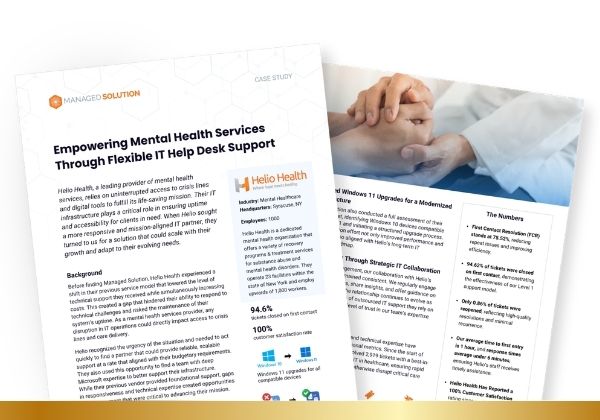
The results demonstrated the value of scalable IT support and after hours help desk services in a real-world environment:
- 94.6% of tickets closed on first contact
- 100% customer satisfaction
- More than 2,919 tickets resolved
- 75.5% First Contact Resolution rate
- Faster response times and improved uptime reliability
By combining Microsoft expertise, responsive IT help desk services, and flexible MSP support models, Helio Health gained a more stable and scalable IT environment capable of supporting life-saving care around the clock. Get the case study below to read the full story.
Final Thoughts: Choosing the Right After Hours Help Desk Provider
Technology issues do not stop after business hours, and businesses need support models that reflect that reality. After hours help desk services combined with flexible MSP pricing models give organizations the ability to stay responsive, control costs, and scale support as they grow.
Whether your company needs Tier 1 help desk support, a fully managed IT service desk, or customizable MSP packages with usage based billing, choosing the right provider can improve both operational efficiency and long-term IT planning.
The best managed service providers focus on scalable IT support that adapts to your business instead of forcing your business to adapt to a rigid contract.
Ready to build an IT support strategy that works for your business today and scales for tomorrow?
Chat with one of our experts to learn how flexible MSP pricing, after hours IT support, and customizable service desk solutions can help your organization stay productive, secure, and supported at every stage of growth.