


Artificial intelligence has become one of the biggest disruptors in cybersecurity, but not only for defenders. Cybercriminals are also leveraging AI to automate phishing campaigns, identify software vulnerabilities faster, generate convincing social engineering attacks, and scale cybercrime at a pace that traditional security operations struggle to match.
Security teams are feeling that pressure every day. Alert volumes continue to rise, attack surfaces are expanding, and the ongoing cybersecurity talent shortage leaves many organizations with more responsibilities than available resources. It is no surprise that AI has quickly become one of the cybersecurity industry’s biggest areas of investment.
However, enthusiasm for AI is not universal. Business leaders often view AI as an opportunity to improve efficiency, strengthen defenses, and address resource challenges. Frontline security analysts often have a different perspective. They are responsible for validating AI recommendations, investigating alerts, and managing the consequences when automated decisions are incorrect.
Concerns around AI hallucinations, false positives, limited context, and trust are legitimate, especially in cybersecurity environments where a single mistake can lead to significant operational or financial consequences.
This difference in perspective does not mean one group is right and the other is wrong. Instead, it highlights an important reality: successful AI adoption in cybersecurity depends as much on governance, transparency, and workflow design as it does on the technology itself.
Fortunately, AI in cybersecurity is evolving rapidly. New approaches from security leaders like Microsoft are moving beyond basic chatbots and standalone AI assistants toward purpose-built security models, specialized AI agents, and intelligent systems that continuously monitor environments, analyze threats, and help security teams respond faster while keeping humans in control.
This shift has the potential to redefine how organizations approach AI in cybersecurity for 2026.
Table of Contents
The Role of AI in Modern Cybersecurity
The pace of cyberattacks has changed dramatically over the last several years. Attackers now use AI to analyze massive codebases, automate reconnaissance, personalize phishing campaigns, and identify potential attack paths across increasingly complex environments.
Microsoft recently highlighted how AI is reducing the time and cost required to identify software vulnerabilities by allowing security researchers to analyze large volumes of code far more efficiently than traditional approaches. As attackers gain access to similar capabilities, periodic vulnerability scans and reactive security strategies become increasingly difficult to sustain.
Security teams are also facing another challenge and that is the sheer volume and speed of AI-powered cyberattacks.
AI in Cybersecurity by the Numbers
- The IBM Cost of a Data Breach Report 2025 found that $1.9 million lower average breach costs for organizations extensively using AI and automation in security.
- This same report found that the global average cost of a data breach remains $4.44 million
- Organizations using AI reduced breach identification and containment by an average of 80 days.
- 97% of organizations experiencing AI-related security incidents lacked proper AI access controls.
- 63% of organizations still lack mature AI governance policies.
- Gartner predicts that AI-augmented security operations will become the standard operating model for modern Security Operations Centers (SOCs) over the next several years.
Modern organizations generate millions of security signals every day across identities, endpoints, cloud platforms, applications, and data environments. Even experienced security analysts cannot manually process and correlate every piece of information quickly enough to keep pace with machine-speed attacks.
This is where AI-powered security solutions are becoming increasingly valuable. AI can help security teams:
- Detect threats faster by analyzing large volumes of security data and identifying suspicious patterns
- Automate repetitive tasks such as alert triage, investigation summaries, and response workflows
- Improve threat intelligence by connecting signals across identities, devices, applications, and cloud environments
- Prioritize risk by helping analysts focus on the vulnerabilities and incidents that pose the greatest business impact
- Strengthen security operations by providing analysts with additional context and recommendations
Key AI Cybersecurity Technologies
AI tools for cybersecurity typically rely on several core technologies working together.
Machine Learning and Pattern Recognition
Machine learning enables cybersecurity systems to analyze historical data, identify normal behavior, and detect anomalies that may indicate malicious activity. Instead of relying only on predefined rules, AI can recognize emerging attack patterns and adapt as threats evolve.
Natural Language Processing (NLP)
Natural language processing allows AI systems to understand and analyze human language. In cybersecurity, NLP helps analyze phishing emails, security reports, threat intelligence feeds, and incident documentation to identify potential risks.
Large Language Models (LLMs)
Large language models power many modern AI assistants by allowing systems to interpret complex questions, summarize information, and provide recommendations. In security environments, LLMs can help analysts investigate incidents, understand vulnerabilities, and accelerate decision-making.
AI Agents and Automation
AI agents represent the next evolution of cybersecurity automation. Instead of simply responding to prompts, AI agents can perform specialized tasks, analyze information, coordinate workflows, and recommend actions across security operations.
Microsoft’s approach to agentic security focuses on using specialized AI agents that work alongside security teams to investigate threats, identify vulnerabilities, and automate portions of the response process.
Generative AI vs. AI Agents vs. Agentic Security
Feature | Generative AI | AI Agents | Agentic Security |
Primary Purpose | Generate content and answer questions | Perform specific tasks autonomously | Coordinate multiple AI agents across the security lifecycle |
Interaction Style | Responds to user prompts | Takes actions based on goals and workflows | Continuously monitors, reasons, and acts across security operations |
Level of Autonomy | Low | Moderate | High (with human oversight) |
Decision Making | Generates recommendations | Makes task-level decisions within defined parameters | Collaborates across multiple agents to investigate, prioritize, and remediate threats |
Context Awareness | Limited to the current conversation and available data | Maintains context for assigned workflows | Continuously correlates identities, endpoints, cloud workloads, applications, threat intelligence, and security telemetry |
Typical Cybersecurity Uses | Incident summaries, report generation, phishing analysis, documentation | Malware analysis, vulnerability triage, ticket creation, automated investigations | Threat detection, attack path analysis, incident response, vulnerability management, remediation orchestration |
Human Involvement | Human initiates every interaction | Human supervises workflows and approves critical actions | Humans remain in control while AI assists across the entire Security Operations Center (SOC) |
Business Value | Improves productivity and knowledge sharing | Automates repetitive security tasks | Creates an AI-assisted SOC capable of responding faster, reducing analyst fatigue, and improving overall security posture |
According to recent research, 96% of cybersecurity professionals say AI has improved their efficiency. At the same time, organizations recognize that adopting AI successfully requires more than simply purchasing new tools. Research also shows that 85% of security leaders prefer expanding their security capabilities through managed security service providers rather than building every AI capability internally.
As most organizations are using AI for Cybersecurity at some level, the conversation is shifting from whether organizations should use AI, to what responsible implement it responsibly, securely, and in ways that genuinely support security teams.
AI’s Impact on Security Jobs
One of the biggest concerns surrounding AI adoption is, understandably, job security.
For cybersecurity professionals, the question is not whether automation will change their roles. It already is. The larger question is how organizations can use AI to enhance security teams while maintaining human oversight and accountability.
AI excels at processing enormous volumes of telemetry, correlating alerts, identifying patterns, summarizing incidents, and automating repetitive workflows that would otherwise consume valuable analyst time.
However, human expertise remains critical.
Security professionals provide the judgment AI cannot replicate. They investigate complex attacks, understand business context, evaluate risk, communicate with stakeholders, develop security strategies, and make decisions when situations require nuance.
As AI continues to mature, cybersecurity teams may spend less time manually sorting through alerts and more time focusing on higher-value activities such as threat hunting, incident response, security architecture, vulnerability management, risk reduction strategies, and security governance.
Rather than replacing cybersecurity professionals, AI has the potential to help teams operate more effectively by reducing repetitive workloads and allowing experts to focus on strategic security initiatives.
The future of cybersecurity will likely depend on a partnership between human expertise and intelligent automation. Organizations that successfully integrate AI will be those that empower their teams with better tools while maintaining strong oversight and accountability.
Why Many Cybersecurity Professionals Remain Cautious
Building powerful AI models is one thing, but when it comes to cybersecurity building trust is understandably more complex.
Anyone working in a Security Operations Center knows that every alert matters. False positives create unnecessary work. False negatives can leave organizations exposed. When an AI model recommends isolating a device, blocking an account, or prioritizing one incident over another, security professionals still need confidence that recommendation is accurate.
Hallucinations remain one of the biggest concerns surrounding AI in cybersecurity. AI models can occasionally produce incorrect or incomplete information with remarkable confidence. In cybersecurity, that risk carries much higher stakes than a simple factual error.
There are also important operational questions that organizations continue to work through:
- When should AI make recommendations versus take action?
- How much human validation should be required?
- Who is accountable if an automated decision causes business disruption?
- How should organizations govern AI across their security operations?
The bottom line here is that organizations are taking a thoughtful approach to integrating AI into critical security workflows and in today’s cyber climate it’s the best approach they can take.
Best Practices for Using AI in Cybersecurity
Successfully adopting AI requires more than deploying a new platform. Organizations should build a strategy that balances automation with human expertise.
Here are several best practices that can help maximize the value of AI while reducing risk.
Keep Humans in the Loop
AI should augment security analysts, not replace them. Automated recommendations should be reviewed before high-impact actions are taken, particularly when they affect users, production systems, or business-critical applications.
Establish AI Governance
Develop clear policies for how AI is used across the organization. Define approval workflows, assign ownership, establish audit requirements, and regularly evaluate model performance to ensure AI systems remain accurate and aligned with business objectives.
Prioritize High-Value Use Cases
Organizations often achieve the greatest return by using AI to automate repetitive, time-consuming tasks such as alert triage, log analysis, vulnerability prioritization, phishing detection, and incident summaries. These use cases improve efficiency while allowing analysts to focus on strategic investigations.
Invest in Training
Security teams should understand both the strengths and limitations of AI-powered tools. Ongoing education helps analysts recognize when AI recommendations require additional validation and builds confidence in working alongside intelligent systems.
Partner with Experienced Security Experts
Many organizations lack the internal resources to implement and manage AI-powered security technologies effectively. Working with a trusted Managed Service Provider or Microsoft Solutions Partner can accelerate deployment, improve governance, and ensure organizations are getting the most value from their security investments.
Project Perception: Microsoft’s New AI Security Cyber Stack
One of the biggest shifts in cybersecurity 2026 is not simply the availability of better AI models. It is how those models are being deployed.
With the unveiling of Microsoft’s Project Perception, rather than relying on a single AI assistant Microsoft is introducing an agentic approach to cybersecurity where multiple specialized AI agents collaborate across different stages of the security lifecycle.
Specifically, the Project Perception platform includes specialized Red Team, Blue Team, and Green Team AI agents that collaborate to discover vulnerabilities, investigate threats, validate defenses, and recommend remediation.
To put it more comprehensively, these AI agents can:
- Identify potential attack paths
- Investigate suspicious activity
- Correlate security signals across environments
- Prioritize incidents based on business risk
- Recommend remediation steps
- Automate repetitive security workflows
- Continuously monitor changing environments
This approach represents a significant evolution from traditional security automation. Instead of operating independently, specialized AI agents work together, sharing context and coordinating actions while allowing security teams to remain in control.
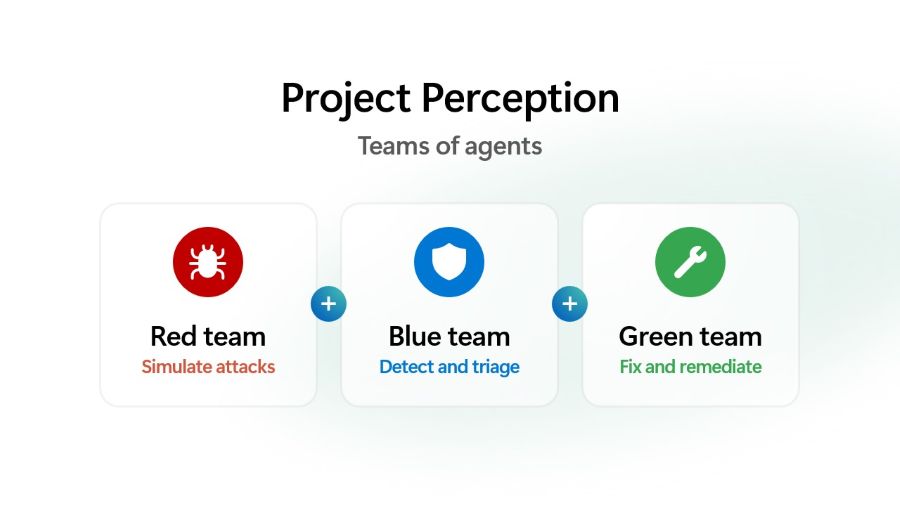
Note: Project Perception will be entering public preview on August 3rd and is currently being brought to select customers like Nationwide who are leveraging the agentic workflows to track and mitigate threats and build a more proactive security structure in an increasingly AI-driven cybercrime climate.
This emerging Cyber Stack further combines telemetry from Microsoft Security products, contextual intelligence, multiple AI models, orchestration capabilities, and automated workflows into a continuously learning security ecosystem.
Rather than replacing analysts, Microsoft’s goal is to reduce repetitive work so security professionals can focus on higher-value investigations and strategic decision-making.
Another important shaping cybersecurity is the emergence of AI models built specifically for security tasks.
General-purpose large language models are incredibly capable, but cybersecurity requires specialized reasoning, technical expertise, and an understanding of rapidly evolving threats.
To address this need, Microsoft recently introduced MAI-Cyber-1-Flash, a compact AI model designed specifically for vulnerability identification.
Integrated into Microsoft’s MDASH (Multi-Agent Detection, Analysis, and Security Harness) platform, MAI-Cyber-1-Flash achieved a 96% score on Microsoft’s CyberGym benchmark while reducing operating costs by nearly 50% compared to previous configurations.
What makes this architecture particularly compelling is its efficiency.
Rather than relying on a single foundation model for every task, Microsoft’s multi-model approach routes routine vulnerability analysis to specialized cybersecurity models while reserving larger AI models for more complex investigations. This allows organizations to improve speed, reduce costs, and increase scalability without sacrificing accuracy.
Purpose-built models like MAI-Cyber-1-Flash also demonstrate an important industry shift. Instead of adapting general-purpose AI for cybersecurity, vendors are increasingly designing AI systems specifically for security operations from the ground up.
As these specialized models continue to mature, organizations can expect faster investigations, improved vulnerability discovery, and more reliable AI-assisted decision-making.
Another Major Trend for 2026: Security Outsourcing
Adopting AI-powered cybersecurity isn’t simply a matter of purchasing software.
Organizations must evaluate platforms, integrate new tools into existing environments, establish governance, train teams, monitor model performance, and continuously optimize workflows as AI capabilities evolve.
For many businesses, that’s a significant undertaking.
Recent research shows that 85% of cybersecurity professionals would rather expand their security capabilities through managed security service providers or than build every capability internally. Managed service providers can help organizations navigate platform selection, implement Security solutions, configure AI-powered workflows, establish governance, and ensure security teams are equipped to use these technologies effectively.
For organizations invested or considering investing in the Microsoft ecosystem, working with experienced Microsoft security specialists can also help maximize the value of tools such as Microsoft Defender, Microsoft Sentinel, Microsoft Security Copilot, and emerging AI-driven security capabilities as they become available.
The Future of Cybersecurity and AI
Cybersecurity has reached an important moment.
AI is changing both sides of the threat landscape. Attackers are moving faster, automating more of their operations, and discovering new ways to exploit vulnerabilities. Defenders need technology that can operate at a similar pace while remaining transparent, reliable, and accountable.
The organizations that benefit most from AI won’t necessarily be the ones deploying the newest tools first. They’ll be the ones that invest in thoughtful implementation, strong governance, skilled security professionals, and technologies designed to strengthen human decision-making rather than replace it.
As purpose-built cyber models, multi-agent security platforms, and AI-native security operations continue to mature, 2026 may ultimately be remembered as the year AI became a trusted partner for cybersecurity teams because this year marks the moment AI-powered cybersecurity technology can finally begin working alongside people in more meaningful and reliable ways.
Ready to Modernize Your Security Strategy?
AI-powered cybersecurity is evolving rapidly, and implementing these technologies effectively requires the right strategy, governance, and expertise.
Whether you’re exploring traditional Microsoft Security tools from Microsoft Defender, Microsoft Sentinel, or the latest advancements in agentic AI, partnering with an experienced Microsoft Solutions Partner can help you maximize your investment while strengthening your overall security posture.
Connect with one of our Microsoft security experts to learn how Managed Solution can help your organization deploy, manage, and optimize Microsoft’s powerful security technologies.